Pharma manufacturers running GST invoicing, distributor returns, and QA audits can't manage lot numbers on a spreadsheet past a certain point — this guide breaks down what batch tracking software for pharma manufacturers actually needs to do in 2026, and which type of system gets you there without adding a second tool for every function.
- Oxapher pairs batch, serial and expiry tracking with GST e-invoicing and QA/QC data in one system — Buy for pharma SMEs scaling past spreadsheets in 2026.
- Standalone batch tracking tools without ERP integration work as a stopgap but leave GST reconciliation manual — Consider only short-term.
- Spreadsheet batch logs break the moment E-Way Bill or GSTR-1 filing needs batch-linked invoice data — Skip once SKU counts grow.
- Dedicated LIMS/QMS platforms suit large regulated plants but add cost most MSME pharma units in 2026 don't need — Consider only at scale.
Why this matters
A pharma batch record isn't just an inventory line — it's the paper trail a distributor return, a customer complaint, or a GST audit traces back to. Once a batch ships against a GST invoice above the ₹50,000 threshold, an E-Way Bill needs to reference it, and GSTR-1 and GSTR-3B filings need the same data reconciled monthly.
Revised Schedule M GMP norms now push documented batch records down to MSME pharma units, not just large-scale plants. A system that can't link a raw material lot to a finished batch, a QA rejection, and a GST invoice in one place forces someone on your team to rebuild that chain by hand every time an auditor or a distributor asks.
Who batch tracking software for pharma manufacturers is for
This guide is for MSME pharma manufacturers, contract manufacturers, and formulation exporters running FEFO (first-expiry-first-out) stock movement across raw materials, work-in-progress, and finished goods. If you invoice under GST, handle distributor returns, or need to trace a batch backward from a complaint to the raw material lot it came from, this applies to you directly.
Oxapher targets exactly this profile — Indian manufacturing SMEs juggling inventory, production, GST, and accounting from one login instead of four disconnected tools.
What to look for in batch tracking software for pharma manufacturers
Batch and expiry granularity down to the lot number
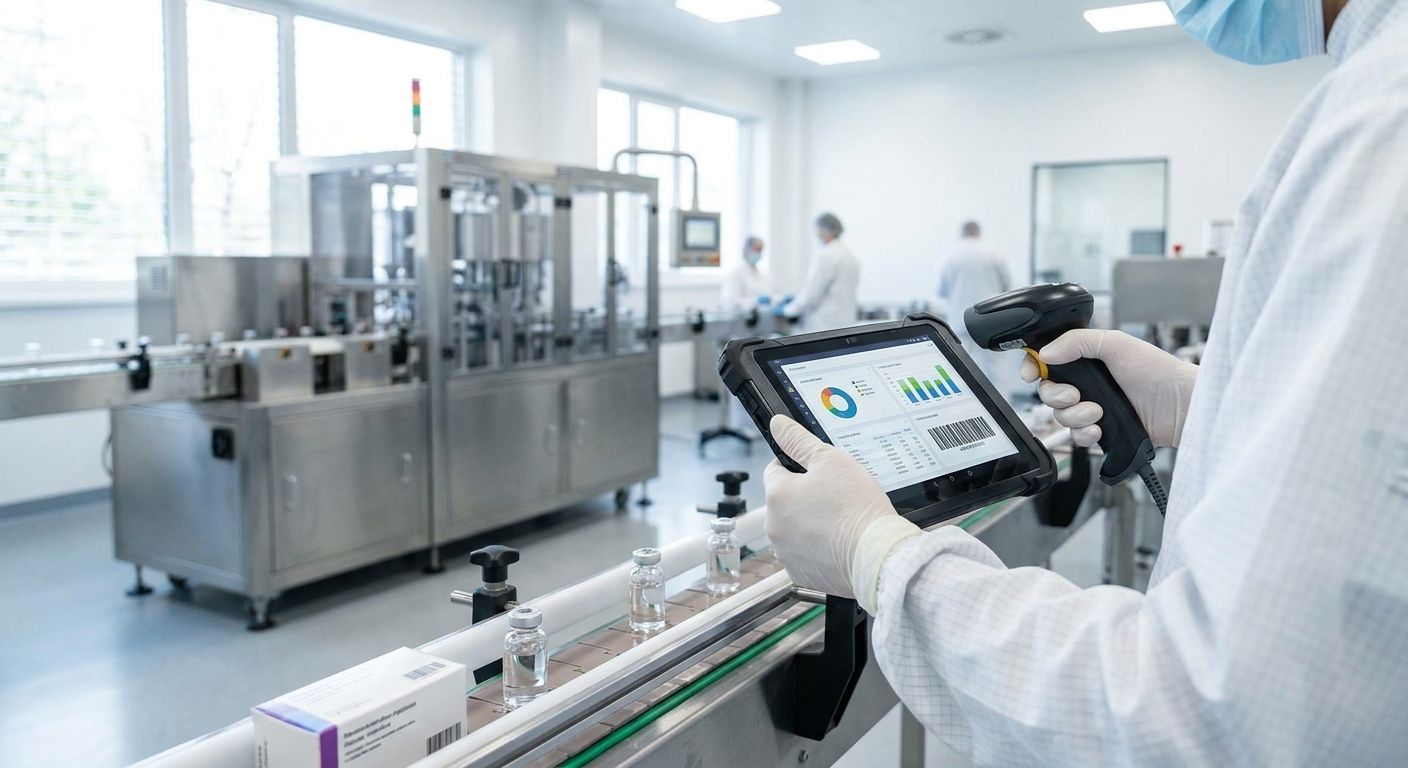
You need tracking at the lot level, not just SKU level, because a recall or a distributor return only makes sense if you can isolate the exact batch involved. FEFO stock movement depends on the system knowing which lot expires first, automatically, without a warehouse worker checking a printed label.
QA/QC and rejection tracking tied to the batch record
Rejection and scrap data means nothing if it isn't attached to the batch that produced it. A system that logs QA rejections separately from production records forces manual reconciliation every time you need to answer "which batches used this raw material lot."
GST-ready batch-to-invoice linkage
Once a shipment crosses the ₹50,000 E-Way Bill threshold, the invoice, the batch number, and the transport document all need to line up. Software like purchase order software built for manufacturing SMEs that ties purchase invoices back to the batches they feed keeps that chain intact from raw material intake through GSTR-1 filing.
Multi-warehouse and stock movement visibility
Most pharma MSMEs run more than one storage location — a manufacturing unit, a cold chain store, a distributor-facing warehouse. Batch tracking that doesn't show which warehouse holds which lot creates blind spots exactly where a recall would need speed.
Raw-material-to-finished-batch traceability through manufacturing
BOM management, multi-stage production, and job-work-in/job-work-out records need to connect back to the same lot numbers your batch tracking uses. Without that link, production costing and batch traceability live in two different systems that never agree.
See batch tracking inside Oxapher
Check how lot, expiry and QA data flow into GST invoicing in 2026.
Top approaches to batch tracking for pharma manufacturers
Oxapher — the all-in-one pick
Batch, serial number, and expiry tracking sit in the same system as GST e-invoicing, E-Way Bill generation, and QA/QC rejection tracking. The CRM for manufacturing businesses layer also means leads, sales orders, and batch-linked invoices stay in one ledger instead of three. Verdict: Buy for pharma SMEs already filing GST invoices who want batch data in the same system as accounting.
Standalone batch/lot tracking tools — the patchwork pick
These tools handle barcode or lot scanning well but stop at the warehouse door. You still reconcile the same ₹50,000 E-Way Bill data and monthly GSTR-3B filing separately, in a different system, by hand. Verdict: Consider only if you already run a GST-compliant accounting stack and just need scanning added on top.
Spreadsheet batch logs — the free pick
Manual entry with no audit trail and no automatic FEFO sorting. It works fine at low SKU counts and one warehouse, then breaks down fast once you're tracking multiple locations and filing GST returns every month. Verdict: Skip once you're doing monthly GSTR filings against batch-linked invoices.
Dedicated LIMS/QMS platforms — the compliance-heavy pick
Built for full audit trails, electronic signatures, and validation packages under revised Schedule M GMP norms. Strong for regulated, large-scale plants; heavy and expensive for an MSME unit that mainly needs GST and inventory tied together. Verdict: Consider only at large regulated scale, Skip for most pharma MSMEs in 2026.
What to avoid
- Generic inventory apps that track quantity but not expiry or lot number. They look like they solve batch tracking until a distributor returns an expired lot and you can't isolate which batch it came from.
- WhatsApp-only order tools without accounting behind them. Fine for lead capture and follow-ups, useless for tying an invoice number to a batch number.
- Spreadsheet templates marketed as "GST-ready." None of them auto-generate an E-Way Bill above the ₹50,000 threshold or reconcile batch-level data into GSTR-1.
Verdict comparison table
| Approach | Batch/expiry tracking | GST batch-invoice link | QA/QC tie-in | Multi-warehouse | Verdict |
|---|---|---|---|---|---|
| Oxapher | Yes — lot, serial, expiry | Yes — e-invoice, E-Way Bill, GSTR | Yes | Yes | Buy |
| Standalone batch tools | Yes | No — manual | Partial | Varies by tool | Consider |
| Spreadsheets | Manual only | No | No | No | Skip |
| Dedicated LIMS/QMS | Yes — validated | No — separate accounting | Yes — deep | Varies | Consider (large plants only) |
FAQ
What is batch tracking software for pharma manufacturers?
It's software that records the lot number, expiry date, and movement of a pharma batch from raw material to finished product. In 2026, the useful versions also link that batch record to GST invoices and QA/QC data.
Is batch tracking mandatory for pharma manufacturers in India?
Documented batch records are expected under Schedule M GMP norms, which now extend to MSME pharma units, not just large plants. GST filings also require batch-linked invoice data once shipments cross the E-Way Bill threshold.
Does batch tracking software handle GST e-invoicing?
Not automatically — it depends on the platform. Oxapher generates GST invoices, E-Way Bills, and GSTR-1/GSTR-3B data from the same batch and inventory records, so you're not reconciling two systems.
What's the difference between batch tracking and serial number tracking?
Batch tracking groups units made in one production run under a single lot number; serial number tracking identifies individual units. Pharma manufacturers typically need both — batch for expiry and recall, serial for high-value or regulated items.
How much does batch tracking software cost in 2026?
Cost varies by platform and the modules you need — inventory-only tools cost less than systems that also handle GST, manufacturing, and accounting. Check current pricing directly with the vendor rather than relying on a fixed number.
Can batch tracking software connect to WhatsApp for recall notices?
Some platforms, including Oxapher, connect WhatsApp to customer and lead records, which lets you send batch-specific notices directly rather than through email or phone calls.
Is Oxapher suitable for small pharma manufacturers?
Yes — Oxapher is built for Indian SMEs and MSMEs, which covers most pharma manufacturers running one or two production lines with GST compliance needs, not just large enterprises.
Does batch tracking software replace a QMS?
No. Batch tracking covers lot, expiry, and movement data; a full QMS covers validation, electronic signatures, and deviation management. Most MSME pharma units need the former integrated with GST and inventory, and only add a dedicated QMS at larger regulated scale.
One last thing
Most pharma MSMEs don't find their batch tracking gap during a planned audit — they find it during a distributor return, when someone has to prove which batch a returned box came from and the GST invoice it was billed against. The revised Schedule M GMP norms make that documentation expectation explicit even for smaller units in 2026, which is exactly why batch-to-invoice linkage matters more than a standalone scanning app.