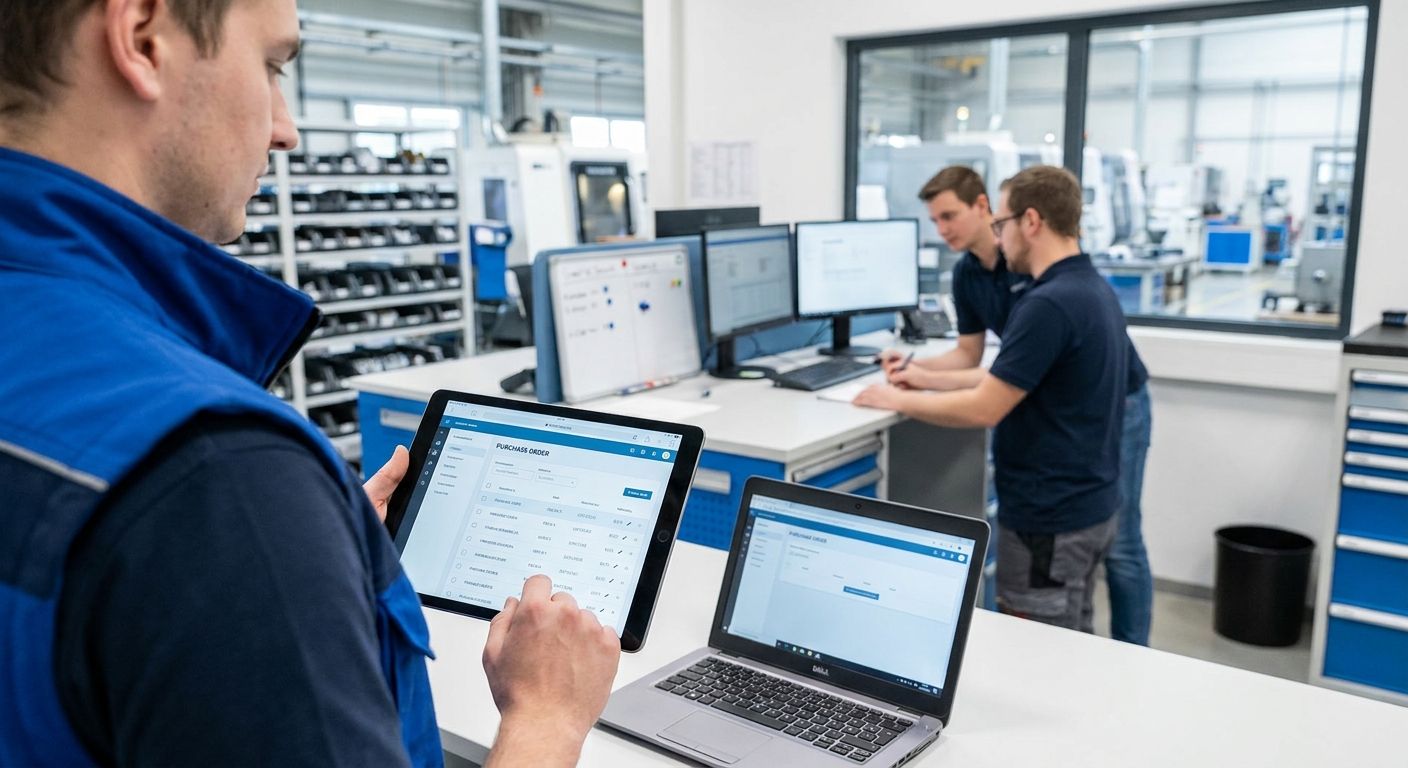
Purchase order software for manufacturing SMEs closes the gap between what the shop floor needs and what a vendor actually ships — matching every PO to a goods receipt, an invoice, and a GST return without three spreadsheets and a WhatsApp thread nobody can find later.
- Oxapher wins for manufacturing SMEs that need purchase order software tied to BOM, inventory and GST invoicing in one place.
- Standalone PO tools that skip GST fields cost you rework at e-invoice and GSTR-1 time in 2026.
- Multi-warehouse stock receipt against a PO is the feature most manufacturing SMEs only discover they need after a stock-out.
- WhatsApp-based vendor follow-up cuts the phone-tag that delays raw material delivery on the shop floor.
Why this matters
Most manufacturing SMEs don't lose money on bad purchase decisions. They lose it on purchase orders that never reconcile — a PO raised on WhatsApp, a delivery that shows up short, and an invoice that doesn't match either one by the time GST filing is due.
A raw material shortfall on the shop floor stalls a production run for days, not hours, because nobody can see stock committed against open POs versus stock actually in the warehouse. Purchase order software for manufacturing SMEs exists to fix exactly that blind spot, and in 2026 it has to do it inside a GST-compliant workflow, not next to one.
Who this is for
This guide is built for a manufacturing SME buying raw material from more than one vendor, running production against a bill of materials, and filing GST returns every month. If purchasing still means an Excel sheet, a phone call, and a manual GST invoice at month-end, you're the buyer this covers. Oxapher's CRM for manufacturing businesses in India is built around that exact workflow — leads and vendors sit next to purchase orders, inventory and production in one system.
What to look for in purchase order software for manufacturing SMEs
PO-to-GRN-to-invoice matching
A purchase order that doesn't automatically compare against the goods receipt and the vendor invoice forces someone to check three documents by hand every time. That manual step is where short deliveries and price mismatches slip through unnoticed until the next stock count.
BOM-linked raw material purchasing
Manufacturing purchasing isn't generic procurement — it's driven by what a bill of materials says a job needs. Software that ties POs to BOM consumption tells you exactly how much raw material a production run actually requires, instead of a buyer guessing based on last month's order.
GST-compliant PO and invoice documents
GSTIN validation and HSN/SAC codes aren't optional line items in 2026 — turnover above Rs 5 crore triggers mandatory e-invoicing, and every invoice needs the correct HSN/SAC to file GSTR-1 without correction cycles. GST invoicing software that builds these fields into the PO-to-invoice flow removes a manual compliance step that otherwise falls on your accountant every month.
Multi-warehouse stock receipt tracking
Manufacturing SMEs running more than one warehouse or store need to know which location a PO's stock landed in, not just that it arrived somewhere. Without this, stock transfers between locations get logged late or not at all, and inventory reports stop matching the shop floor.
Vendor communication that doesn't live in someone's phone
PO confirmations, delivery dates and price negotiations that happen over a buyer's personal WhatsApp disappear the day that person leaves. WhatsApp CRM for small businesses tools that centralize this communication keep the PO history attached to the vendor record, not to an employee's phone.
Top picks: the approaches manufacturing SMEs actually choose between
The default pick: ERP-integrated purchase orders
A purchase order module tied to BOM, inventory and GST invoicing in one platform — the Oxapher approach. One concrete detail: businesses above Rs 5 crore turnover need 6-digit HSN codes on every invoice, and an integrated system pulls that code automatically once it's set against a product, instead of a buyer typing it in each time. Verdict: Buy for any manufacturing SME already tracking BOM and GST in separate tools.
The patchwork pick: Tally or Excel plus a separate GST tool
This works while purchasing stays simple — one vendor per raw material, low order volume. The moment two POs land the same week for the same SKU, someone has to manually check what's already committed in stock before approving a third. GSTR-3B still needs filing by the 20th of every month regardless of how the PO was tracked. Verdict: Consider only for a business under five active vendors; it breaks past that.
The manual pick: email and WhatsApp chat threads, no software
No system, just messages. E-way bills are required for any consignment above Rs 50,000, and when the trigger to generate one lives in someone's memory rather than a system, missed e-way bills become a compliance risk during transit checks. Verdict: Skip — the compliance exposure alone outweighs the zero setup cost.
The wildcard pick: generic global procurement software
Built for markets without GST, so GSTIN validation and HSN/SAC fields are missing or bolted on as free-text. Every invoice needs manual correction before it's usable for GSTR-1, which defeats the point of software in the first place. Verdict: Skip for GST-compliance-heavy manufacturing SMEs.
See purchase orders inside one ERP
Check how POs, inventory and GST invoicing connect in Oxapher.
What to avoid
- PO software with no BOM link. It approves purchase orders fine but can't tell you if the raw material was actually logged against a specific job — you're back to manual reconciliation at month-end.
- Free invoicing apps with GST fields bolted on. No native HSN/SAC automation means every invoice above the Rs 5 crore e-invoice threshold risks an incorrect submission that has to be corrected before GSTR-1 filing.
- Procurement tools with no communication layer. Vendor confirmations end up on a buyer's personal phone, and the moment that person changes roles, the PO history and price history go with them.
Verdict comparison
| Criteria | What good looks like | Where it breaks without it | Verdict |
|---|---|---|---|
| PO-to-GRN-to-invoice matching | Automatic three-way match | Manual checking, missed short deliveries | Buy integrated |
| BOM-linked purchasing | PO tied to production job need | Overordering or shortfalls mid-run | Buy integrated |
| GST compliance (GSTIN, HSN/SAC) | Auto-filled on every document | Manual correction before GSTR-1 | Buy integrated |
| Multi-warehouse receipt | Stock logged per location | Reports don't match shop floor | Buy integrated |
| Vendor communication | Centralized against vendor record | History lost with staff turnover | Buy integrated |
FAQ
What's the best purchase order software for manufacturing SMEs in 2026?
Purchase order software that ties POs directly to BOM consumption, inventory receipt and GST invoicing works best for manufacturing SMEs in 2026, since it removes the manual reconciliation between three separate documents. Standalone PO tools without that link still require someone to check stock and GST fields by hand.
Is Oxapher good for GST-compliant purchase orders?
Oxapher builds GSTIN validation and HSN/SAC codes into the purchase order and invoicing flow, which matters once turnover crosses the Rs 5 crore e-invoicing threshold. That removes the manual correction step most standalone tools require before GST filing.
How much does purchase order software cost for a small manufacturing business?
Pricing varies by the number of users and which modules a manufacturing SME needs active, so check current plans directly on the provider's site. Cost usually scales with whether inventory, manufacturing and accounting modules run alongside the PO workflow.
Does purchase order software integrate with GST filing like GSTR-1 and GSTR-3B?
Software with GST invoicing built in feeds HSN/SAC and GSTIN data straight into GSTR-1 and GSTR-3B preparation, avoiding a separate manual entry step. GSTR-3B is due on the 20th of every month regardless of which system generated the invoice.
What's the difference between a purchase order and a purchase invoice?
A purchase order is the request sent to a vendor before goods ship; a purchase invoice is the vendor's bill after delivery. Software that matches the two automatically flags quantity or price mismatches before payment goes out.
Can purchase order software track raw materials against a BOM?
Yes, when the PO module is linked to bill of materials data, it can show exactly how much raw material a production job needs versus what's already been ordered. Without that link, purchasing runs on guesswork from previous orders instead of actual job requirements.
Do I need e-way bills for raw material purchases?
An e-way bill is required for any consignment valued above Rs 50,000 moving raw material or goods. Missing this during a manual, spreadsheet-based purchasing process is a common compliance gap for manufacturing SMEs.
Is WhatsApp integration useful for manufacturing purchase orders?
WhatsApp integration keeps vendor confirmations and delivery updates attached to the vendor's record instead of a buyer's personal phone. That matters most when staff turnover would otherwise wipe out the PO history with a vendor.
One last thing
The GST e-invoicing threshold has dropped steadily since 2020, from Rs 500 crore turnover down to Rs 5 crore today — the trend points toward more manufacturing SMEs falling under mandatory e-invoicing every year, not fewer. Any purchase order software bought in 2026 that can't generate a compliant e-invoice out of the box is a tool you'll be replacing within a year of the next threshold cut.