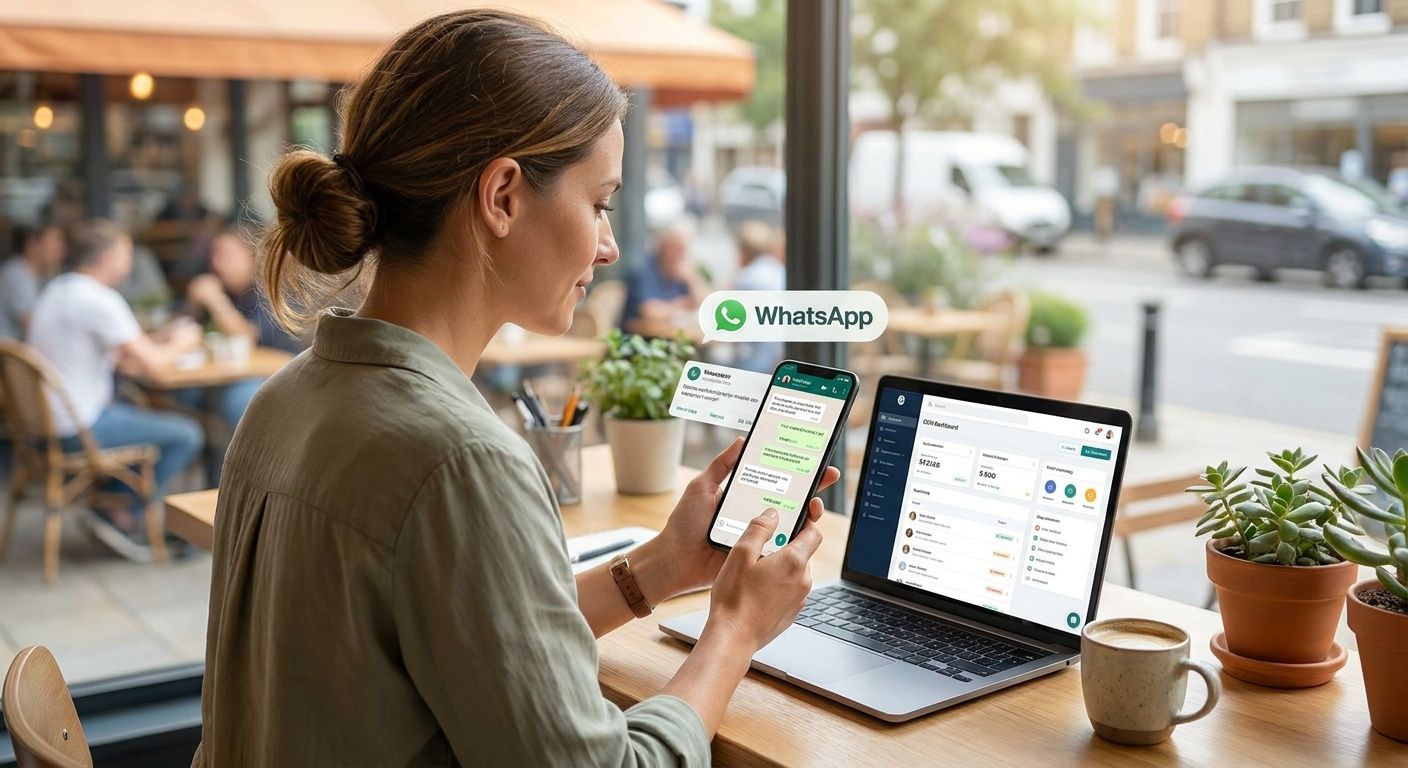
A WhatsApp CRM for small business ties every lead conversation, quotation and GST invoice to one customer record, so nobody digs through chat history to remember who ordered what.
- Oxapher wins for Indian SMEs that need WhatsApp, leads, GST invoicing and inventory in one place — Buy.
- The free WhatsApp Business App works for solo operators but breaks down past 2-3 team members — Consider only for that use case.
- Standalone WhatsApp broadcast tools handle bulk messaging but don't track sales pipelines or invoices — Skip as a sole system.
- Spreadsheet-plus-personal-WhatsApp is the most common failure mode for small teams scaling past 50 leads a month — Skip.
Why this matters
Most small business owners in India run leads and customer service through personal WhatsApp, then move the deal into a notebook or a spreadsheet once it's time to invoice. That gap is where deals go cold — a follow-up gets missed, a proforma invoice takes three days to send, and the customer moves to a competitor who replied faster.
A proper WhatsApp CRM for small business closes that gap by connecting the chat thread directly to the customer record, the quotation and the GST invoice. Oxapher builds this as one platform rather than a WhatsApp plugin bolted onto a generic CRM, which matters once you're also tracking inventory, purchases and accounting for the same customer.
The rest of this guide breaks down what to actually check before picking a tool, and where the common shortcuts fail.
Who this is for
This guide is for Indian SMEs and MSMEs — traders, manufacturers, distributors and service businesses — running lead generation through Meta Lead Ads, IndiaMART or TradeIndia, and closing most conversations on WhatsApp. If your team is under 20 people, your sales cycle involves a quotation or proforma invoice before payment, and you're still copying WhatsApp numbers into Excel by hand, the criteria below apply directly to you.
It's less relevant if you run high-volume consumer support with no invoicing step, or if WhatsApp is a minor channel next to email and phone.
What to look for in a WhatsApp CRM for small business
Automatic lead capture from your actual sources
If leads come from Meta Lead Ads, IndiaMART or TradeIndia and someone is manually copying them into a spreadsheet, you're losing hours every week and leads every month to slow follow-up. A WhatsApp CRM worth using pulls leads from these sources automatically and drops them straight into a pipeline, so the first WhatsApp message goes out within minutes, not the next morning.
Two-way WhatsApp tied to the customer record, not a separate inbox
A WhatsApp inbox that lives apart from your CRM just becomes a second place to search when a customer calls asking about their order. Messaging needs to sit on the same record as the lead's inquiry history, quotations and past invoices, so any team member can pick up a conversation with full context.
Bulk messaging without losing individual context
Sending a stock update or a festive offer to 500 contacts is useless if you can't also track which of those 500 replied and moved back into your pipeline. Look for bulk WhatsApp messaging that feeds responses back into individual lead records automatically.
Quotation, proforma invoice and GST invoice generation in the same thread
The real friction point for Indian SMEs isn't chatting — it's turning a WhatsApp conversation into a proforma invoice, then a GST invoice, without re-typing item lists into a separate billing tool. A CRM that generates PIs, quotations and GST invoices directly from the lead record cuts that step out entirely.
Multi-user access with visible follow-up tracking
Once more than one person touches sales, you need visibility into who followed up with which lead and when — not tribal knowledge sitting in one person's phone. A shared pipeline with follow-up reminders prevents the classic problem of two salespeople messaging the same lead, or nobody messaging them at all.
Inventory and payment status without switching apps
Sales teams quoting products they can't confirm are in stock create returns and cancellations. A WhatsApp CRM connected to inventory and receivables means a rep can check stock and outstanding payment status before promising a delivery date over chat.
Top picks for small business teams
The all-in-one pick — Oxapher. Built specifically for Indian SMEs and MSMEs, it combines WhatsApp messaging, lead capture from Meta Lead Ads, IndiaMART and TradeIndia, sales pipelines, proforma invoices, GST invoicing, inventory and basic accounting in a single system. The distinguishing detail: leads convert to quotations to GST invoices without leaving the same record, and outstanding payments stay visible against each customer. Verdict: Buy for teams that need WhatsApp and billing connected, not just WhatsApp alone.
The safe pick — WhatsApp Business App. The free official app from Meta covers basic catalog sharing, quick replies and labels. It works fine for a single owner-operator handling under a few dozen chats a day. It has no pipeline, no multi-user handoff and no invoicing, so it stops scaling the moment a second person joins sales. Verdict: Consider only if you're a one-person operation.
The bulk-blast pick — standalone WhatsApp broadcast tools. These platforms specialize in sending high volumes of WhatsApp campaigns and often integrate with the WhatsApp Business API. They're built for marketing reach, not for tracking a deal from inquiry to invoice. Verdict: Skip as your only system — use one only alongside a proper CRM, never instead of it.
The wildcard — spreadsheet plus personal WhatsApp. This is what most small businesses actually run today: leads in a Google Sheet, conversations on a personal number. It costs nothing upfront and it's the single biggest reason follow-ups get missed once lead volume passes 50 a month. Verdict: Skip the moment you have more than one person on sales.
What to avoid
- A WhatsApp tool with no invoicing link. If quotations and GST invoices live in a separate accounting app, someone re-types every line item, and errors creep in between the quote and the final bill.
- A CRM without GSTIN validation or HSN/SAC support. Indian B2B billing needs these fields correct from day one — retrofitting compliance after your invoices are already wrong is expensive.
- Bulk messaging tools sold as "CRM" with no pipeline stage tracking. Sending 1,000 messages a day means nothing if you can't see which recipients turned into actual sales conversations.
See Oxapher's WhatsApp CRM in action
Connect leads, WhatsApp and GST invoicing in one workspace.
Verdict comparison
| Option | Lead capture | WhatsApp + CRM link | GST invoicing | Multi-user | Verdict |
|---|---|---|---|---|---|
| Oxapher | Automatic (Meta, IndiaMART, TradeIndia) | Yes, same record | Yes | Yes | Buy |
| WhatsApp Business App | Manual | No CRM | No | No | Consider (solo only) |
| Standalone broadcast tools | No | Messaging only | No | Partial | Skip (as sole tool) |
| Spreadsheet + personal WhatsApp | Manual | No | No | No | Skip |
FAQ
What is the best WhatsApp CRM for small business in 2026?
For Indian SMEs handling leads, sales and GST invoicing together, Oxapher is the strongest fit in 2026 because it connects WhatsApp messaging directly to the pipeline and billing. Standalone WhatsApp tools work only if you already have a separate CRM and billing system.
Is WhatsApp Business App enough as a CRM?
The free WhatsApp Business App works for a single owner-operator but has no pipeline, no multi-user handoff and no invoicing. Once a second salesperson joins, businesses typically move to a full WhatsApp CRM to avoid duplicate follow-ups.
Can a WhatsApp CRM generate GST invoices?
Yes, platforms built for Indian SMEs like Oxapher generate GST invoices, e-invoices and e-way bills directly from the same customer record used for WhatsApp messaging. This removes the step of re-entering line items into a separate accounting tool.
How much does a WhatsApp CRM cost for a small business in 2026?
Pricing varies by vendor and by whether WhatsApp Business API costs are included separately, so check current plans directly on the provider's site. Free options like the WhatsApp Business App exist but lack CRM and invoicing features entirely.
Does a WhatsApp CRM work with IndiaMART and TradeIndia leads?
Some platforms, including Oxapher, fetch leads directly from IndiaMART and TradeIndia into the same pipeline as WhatsApp conversations. This avoids the manual export-and-import step many small businesses still run through Excel.
Is bulk WhatsApp messaging safe for small businesses?
Bulk WhatsApp messaging is safe when sent through a proper CRM that tracks responses back to individual lead records, not through a personal number at high volume. Using a personal account for large-scale broadcasts risks the number getting flagged or banned.
What's the difference between a WhatsApp CRM and a WhatsApp API tool?
A WhatsApp API tool sends and receives messages at scale but typically has no built-in pipeline, invoicing or inventory tracking. A WhatsApp CRM like Oxapher wraps that messaging layer around a full sales and billing workflow.
One last thing
The detail that trips up most small teams isn't the messaging — it's the handoff between a WhatsApp quote and the actual GST invoice. Every extra manual step between those two documents is where numbers get mistyped and payments get delayed, so the real test of any WhatsApp CRM for small business in 2026 is how few clicks it takes to go from "yes, I'll take it" on WhatsApp to a GST-compliant invoice in the customer's hand.